

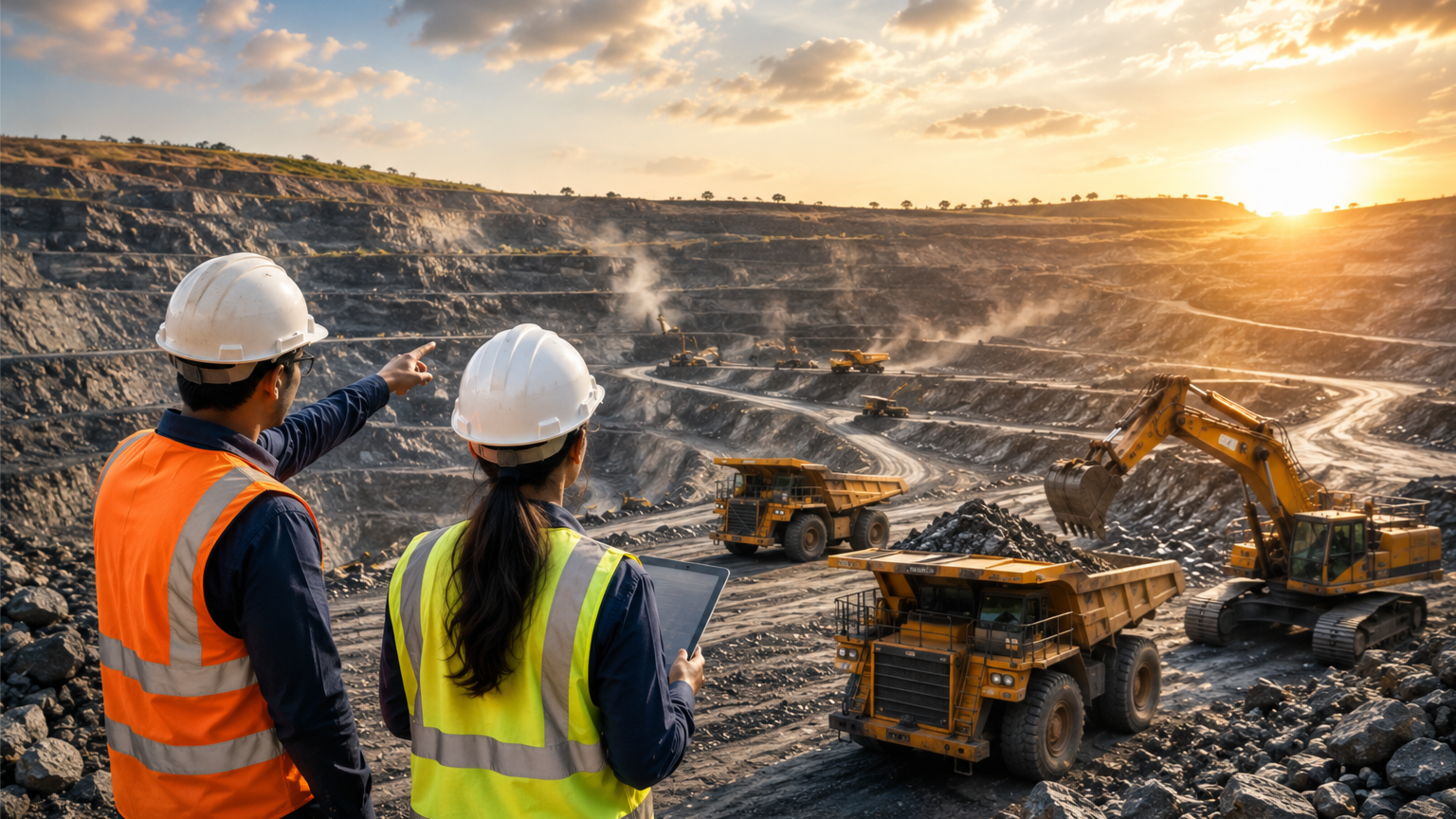

BTech in Mining Engineering is a four-year undergraduate engineering programme focused on mineral exploration, extraction, and mine management.
The course duration is four years, divided into eight semesters.
Candidates must complete Class 12 with Physics, Chemistry, and Mathematics from a recognised board.
JEE Main, JEE Advanced, WBJEE, MHT CET, AP EAMCET, TS EAMCET, KCET, and OJEE are commonly accepted.
The course fee generally ranges from INR 50,000 to INR 12 Lakhs, depending on the college.
Graduates can work as Mining Engineers, Mine Planners, Survey Engineers, Safety Officers, Project Engineers, and Research Engineers.
Fresh graduates can expect salaries ranging from INR 4 LPA to INR 12 LPA, depending on skills and employer.
Yes, it offers strong career prospects in mining, infrastructure, metals, and energy sectors.
Yes, students can pursue MTech, MBA, MS, PhD, and various research programmes.
The future scope is promising due to increasing demand for minerals, automation in mining, and sustainable resource management practices.
Yes. It offers strong PSU recruitment, global opportunities, and tech-driven roles. With the growing demand for minerals and digital mining, career prospects are good.
Freshers in India typically start ₹4–8 LPA. With 5–10 years of experience, ₹8–15 LPA is common. Senior engineers abroad, ₹20–40 LPA. PSU roles start ~₹8–10 LPA (with perks).
IIT (ISM) Dhanbad is India’s flagship (formerly ISM), with legacy & strong placements. IIT Kharagpur and IIT (BHU) Varanasi also have top programs.
Absolutely. Top PSUs such as Coal India, NMDC, MOIL, and NLC regularly recruit mining grads. Government research orgs like GSI/IBM also hire through exams.
Yes. There are no physical restrictions—women work as engineers, managers, or in safety roles. Encouragingly, IIT(ISM) Dhanbad and others admit women in Mining (via JEE).
It’s rigorous, combining engineering with geology. Subjects like rock mechanics and surveying can be challenging. But it’s manageable with interest and hard work.
Yes. Countries such as Australia, Canada, the UAE, Africa, and Chile hire Indian mining engineers for core roles, often at higher pay.
Major recruiters include Coal India, NMDC, Tata Steel, Hindustan Zinc, JSW Steel, Vedanta, Adani, L&T, as well as mining tech firms.
Yes, one of the highest. Among all engineering fields, mining often has a high proportion of PSU job openings (CIL, NMDC, MOIL, etc.), offering stable careers.
GATE is not mandatory for jobs, but valuable. A good GATE score allows entry into MTech programs and direct recruitment by PSUs (many PSUs accept GATE scores).
Key skills include technical aptitude (math, physics), CAD/GIS proficiency, geosciences knowledge, safety awareness, and fieldwork ability. Leadership and communication are also crucial.


